Ideia: representação mental; representação abstrata e geral de um objeto ou relação; conceito; juízo; noção; imagem; opinião; maneira de ver; visão; visão aproximada; plano; projeto; intenção; invenção; expediente; lembrança. Dicionário de Língua Portuguesa da Texto Editora
Mostrar mensagens com a etiqueta Pobreza. Mostrar todas as mensagens
terça-feira, 27 de fevereiro de 2018
"Working Toward the Next Economic Paradigm" - Mohamed A. El-Erian
Etiquetas:
Capitalismo,
Desenvolvimento,
Economia,
Globalização,
Opinião,
Pobreza
segunda-feira, 22 de janeiro de 2018
"AN ECONOMY FOR THE 99%"
Etiquetas:
Desenvolvimento,
Economia,
Globalização,
Pobreza
terça-feira, 31 de outubro de 2017
"Trump Vs. America’s Children: Child Poverty In America Is Indefensible" - Alon Ben-Meir
Etiquetas:
Crianças,
Direitos das Crianças,
Donald Trump,
Economia,
EUA,
Opinião,
Pobreza
sexta-feira, 23 de junho de 2017
"The rise of the cashless city: 'There is this real danger of exclusion'" - Adam Forrest
Etiquetas:
Desenvolvimento,
Dinheiro,
Exclusão Social,
Opinião,
Pobreza
quinta-feira, 15 de junho de 2017
"One in five children in rich countries lives in poverty, UNICEF 'wake-up call' report shows"
Etiquetas:
Crianças,
Direitos das Crianças,
Direitos Humanos,
Pobreza,
UNICEF
segunda-feira, 22 de maio de 2017
"Neoextractivism and other deadly sins of the “progressive left”" - Daniel Cerqueira
Etiquetas:
Ambiente,
América Latina,
Desigualdades,
Esquerda,
Opinião,
Pobreza
quarta-feira, 12 de abril de 2017
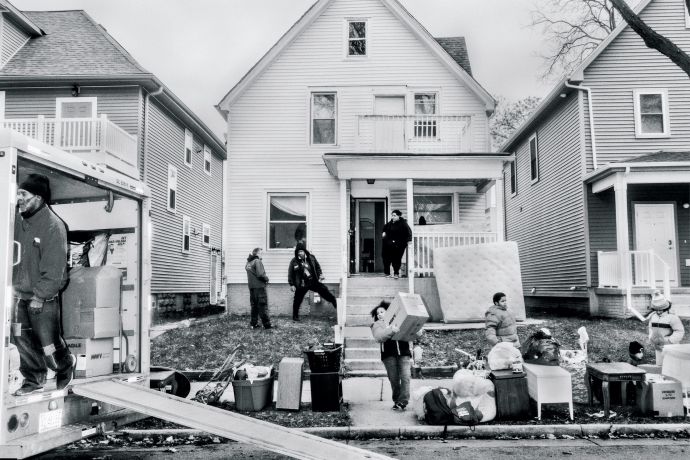
Dossier "Lives in Limbo: Homelessness in America" - "FORCED OUT" by Matthew Desmond
quinta-feira, 23 de março de 2017
Dossier "Lives in Limbo: Homelessness in America" - "NETHERLAND" by Rachel Aviv
Etiquetas:
Cidades,
Desigualdades,
EUA,
Juventude,
Juventude americana,
LGBT,
Nova York,
Pobreza,
Sem abrigo
quinta-feira, 16 de março de 2017
Dossier "Lives in Limbo: Homelessness in America" - "POOR SAMARITAN" by Dorothy Day
Every morning at ten o’clock, as I stood at the kitchen sink and finished the breakfast dishes, I could hear him pecking up the street on his wooden leg. I lived in the basement of a remodelled corner house in the East Fifties. From the front windows on First Avenue I could almost see the East River—anyway, I could hear the boat whistles. The apartment ran the length of the house, so that the kitchen at the back and the small garden adjoining it were adjacent to the side street. I called that tiny patch of ground a garden, and so did the real-estate man who leased me the place, but it held little privacy. It was separated from the street only by a high railing, and passersby could almost tell what we were drinking on those afternoons when I entertained my friends out of doors.
He would stop outside the railing and call to me through the open kitchen door. The first time he appeared, I was about to refuse whatever appeal he might make, for I was continually pestered by tramps and I had grown hard. Then I saw the wooden leg. There was a piece of ham in the icebox, and I cut some bread, buttered it, and made him a sandwich. I handed it to him through the railing and gave him a glass of milk. He put down the small bundle of wood he was carrying and found a niche between my garden and the next house, where he sat down.
“My breakfast nook,” he said. He told me times were hard, a fact of which I was not entirely unaware myself. He had been a piano-maker, he said, but pianos weren’t what they used to be. “The radio, you know, lady.” I said I knew. He went on to tell me that he lived in a cellar on First Avenue and picked up a few cents every day selling wood. When he had finished his breakfast, I offered him a cigarette. He snatched at it so eagerly that I gave him the remainder of the pack and some matches.
These morning calls continued for weeks. I always gave my visitor a sandwich, and milk in the glass which I kept specially for him on the windowsill. One day he appeared pushing his bundle of wood in a baby carriage.
“It’s a great help, lady,” he said. “I found it in a dump heap.”
I made him an egg sandwich that morning, because I had dined out the night before and had no leftovers. It seemed to me that he took it with less relish than usual, and I supposed he didn’t like eggs.
Then he failed to appear for a few days, and I began to worry about him. Each morning I waited for the peck-peck of his wooden leg, and when at last I heard him tapping his way up the street, I ran out into the garden to greet him. There was some nice duck left from the previous night’s dinner, and while duck was not my idea of breakfast, I knew my friend must have less conventional notions about diet.
“Hello!” I called. “I’ve been looking out for you.”
He stopped reluctantly. “Thanks, lady,” he said, “but the people across the street are expecting me, I guess. They been feeding me lately. Thanks just the same.”
There was a smart private house across the street, and the people who lived there gave big dinner parties. Almost every evening I watched the arrival of fashionably dressed guests in limousines. They must have had very nice leftovers.
I never met my friend again. He went all around the block to avoid my house. I guess he didn’t want to hurt my feelings.
Etiquetas:
Desigualdades,
EUA,
Ficção,
Pobreza,
Sem abrigo
terça-feira, 28 de fevereiro de 2017
"The State of the World's Children 2016 - A fair chance for every child"
Every child has the right to health, education and protection, and every society has a stake in expanding children’s opportunities in life. Yet, around the world, millions of children are denied a fair chance for no reason other than the country, gender or circumstances into which they are born. The State of the World’s Children 2016 argues that progress for the most disadvantaged children is not only a moral, but also a strategic imperative. Stakeholders have a clear choice to make: invest in accelerated progress for the children being left behind, or face the consequences of a far more divided world by 2030. At the start of a new development agenda, the report concludes with a set of recommendations to help chart the course towards a more equitable world.
Etiquetas:
Crianças,
Direitos das Crianças,
Fome,
Pobreza,
UNICEF
segunda-feira, 27 de fevereiro de 2017
Dossier "Lives in Limbo: Homelessness in America" - "HIDDEN CITY" by Ian Frazier
Etiquetas:
Desigualdades,
EUA,
Pobreza,
Reportagem,
Sem abrigo
segunda-feira, 16 de janeiro de 2017
"Just 8 men own same wealth as half the world"
Eight men own the same wealth as the 3.6 billion people who make up the poorest half of humanity, according to a new report published by Oxfam today to mark the annual meeting of political and business leaders in Davos.
Oxfam’s report, ‘An economy for the 99 percent’, shows that the gap between rich and poor is far greater than had been feared. It details how big business and the super-rich are fuelling the inequality crisis by dodging taxes, driving down wages and using their power to influence politics. It calls for a fundamental change in the way we manage our economies so that they work for all people, and not just a fortunate few.
New and better data on the distribution of global wealth – particularly in India and China – indicates that the poorest half of the world has less wealth than had been previously thought. Had this new data been available last year, it would have shown that nine billionaires owned the same wealth as the poorest half of the planet, and not 62, as Oxfam calculated at the time.
Winnie Byanyima, Executive Director of Oxfam International, said:
“It is obscene for so much wealth to be held in the hands of so few when 1 in 10 people survive on less than $2 a day. Inequality is trapping hundreds of millions in poverty; it is fracturing our societies and undermining democracy.
“Across the world, people are being left behind. Their wages are stagnating yet corporate bosses take home million dollar bonuses; their health and education services are cut while corporations and the super-rich dodge their taxes; their voices are ignored as governments sing to the tune of big business and a wealthy elite.”
Oxfam’s report shows how our broken economies are funnelling wealth to a rich elite at the expense of the poorest in society, the majority of whom are women. The richest are accumulating wealth at such an astonishing rate that the world could see its first trillionaire in just 25 years. To put this figure in perspective – you would need to spend $1 million every day for 2738 years to spend $1 trillion.
Public anger with inequality is already creating political shockwaves across the globe. Inequality has been cited as a significant factor in the election of Donald Trump in the US, the election of President Duterte in the Philippines, and Brexit in the UK.
Seven out of 10 people live in a country that has seen a rise in inequality in the last 30 years. Between 1988 and 2011 the incomes of the poorest 10 percent increased by just $65 per person, while the incomes of the richest 1 percent grew by $11,800 per person – 182 times as much.
Women, who are often employed in low pay sectors, face high levels of discrimination in the work place, and who take on a disproportionate amount of unpaid care work often find themselves at the bottom of the pile. On current trends it will take 170 years for women to be paid the same as men.
‘An Economy for the 99 percent’ also reveals how big business and the super-rich are fuelling the inequality crisis. It shows how, in order to maximize returns to their wealthy shareholders, big corporations are dodging taxes, driving down wages for their workers and the prices paid to producers, and investing less in their business.
Oxfam interviewed women working in a garment factory in Vietnam who work 12 hours a day, 6 days a week and still struggle to get by on the $1 an hour they earn producing clothes for some of the world’s biggest fashion brands. The CEOs of these companies are some of the highest paid people in the world. Corporate tax dodging costs poor countries at least $100 billion every year. This is enough money to provide an education for the 124 million children who aren’t in school and fund healthcare interventions that could prevent the deaths of at least six million children every year.
The report outlines how the super-rich use a network of tax havens to avoid paying their fair share of tax and an army of wealth managers to secure returns on their investments that would not be available to ordinary savers. Contrary to popular belief, many of the super-rich are not ‘self-made’. Oxfam analysis shows over half the world’s billionaires either inherited their wealth or accumulated it through industries which are prone to corruption and cronyism.
It also demonstrates how big business and the super-rich use their money and connections to ensure government policy works for them. For example, billionaires in Brazil have sought to influence elections and successfully lobbied for a reduction in tax bills while oil corporations in Nigeria have managed to secure generous tax breaks.
Byanyima said: “The millions of people who have been left behind by our broken economies need solutions, not scapegoats. That is why Oxfam is setting out a new common sense approach to managing our economies so that they work for the majority and not just the fortunate few.”
“Governments are not helpless in the face of technological change and market forces. If politicians stop obsessing with GDP, and focus on delivering for all their citizens and not just a wealthy few, a better future is possible for everyone.”
Oxfam’s blueprint for a more human economy includes:
Governments end the extreme concentration of wealth to end poverty. Governments should increase taxes on both wealth and high incomes to ensure a more level playing field, and to generate funds needed to invest in healthcare, education and job creation.
Governments cooperate rather than just compete. Governments should work together to ensure workers are paid a decent wage, and to put a stop to tax dodging and the race to the bottom on corporate tax.
Governments support companies that benefit their workers and society rather than just their shareholders. The multi-billion Euro company Mondragon, is owned by its 74,000 strong workforce. All employees receive a decent wage because its pay structure ensures that the highest paid member of staff earns no more than 9 times the amount of the lowest paid.
Governments ensure economies work for women. They must help to dismantle the barriers to women’s economic progress such as access to education and the unfair burden of unpaid care work.
Oxfam is also calling on business leaders to play their part in building a human economy. The World Economic Forum has responsive and responsible leadership as its key theme this year. They can make a start by committing to pay their fair share of tax and by ensuring their businesses pay a living wage. People around the global can also join the campaign at www.evenitup.org.
Etiquetas:
Desigualdades,
Economia,
Globalização,
Oxfam,
Pobreza
segunda-feira, 12 de dezembro de 2016
António Guterres - Brilhante discurso
Etiquetas:
Ambiente,
Direitos Humanos,
Guerra,
Guterres,
ONU,
Paz,
Pobreza,
Refugiados,
Síria
terça-feira, 1 de novembro de 2016
Assim vai a Europa! - "Creating child poverty for a whole new generation. Take a bow, Theresa May" - Aditya Chakrabortty
I have seen how the new household benefit cuts will tear poor families apart. Even Margaret Thatcher would have balked at this:
Etiquetas:
Desigualdades,
Europa,
Grã-Bretanha,
Opinião,
Pobreza,
União Europeia
segunda-feira, 17 de outubro de 2016
International Day for the Eradication of Poverty/Dia Internacional pela erradição da Pobreza
Uniting all for peace, sustainability and dignity: breaking the vicious circle of poverty
As measured by the 2016 Multi-Dimensional Poverty Index, 1.6 billion persons are identified today as poor. That staggering figure reveals levels of human deprivation far beyond what arbitrary income lines can capture. Poverty is about money, but never just about money, as underlined by UNESCO’s 2016 World Social Science Report. Better understanding of the relationships between income and other dimensions of poverty can help to empower people living in poverty as agents of change.
Delivering the poverty eradication goal of the 2030 Agenda for Sustainable Development demands renewed policy approaches and more comprehensive and sophisticated knowledge. Beyond traditional mechanisms of poverty reduction, poverty can be only solved by tackling inequalities. So long as injustice and exploitation are embedded in economic, social and cultural systems, poverty will continue to devastate the lives of millions of women and men.
Breaking the vicious circle of poverty by 2030 is part of a larger cultural transformation based on solidarity, collaboration and peace to which UNESCO is deeply committed. Through powerful tools for social transformation -- education, culture, science, communication and information -- UNESCO contributes to embedding social justice within societies. Justice is a right, and justice and good governance are foundations for more lasting and sustainable peace.
Ending poverty is not just helping the poor – it is giving every woman and man the chance to live with dignity. By eradicating poverty, all humanity will be transformed. This is UNESCO’s message today.
terça-feira, 4 de outubro de 2016
"Nearly 385 million children living in extreme poverty, says joint World Bank Group – UNICEF study"
Children are more than twice as likely as adults to live in extreme poverty, according to a new analysis from the World Bank Group and UNICEF. Ending Extreme Poverty: A Focus on Children finds that in 2013 19.5 per cent of children in developing countries were living in households that survived on an average of US$1.90 a day or less per person, compared to just 9.2 per cent of adults. Globally, almost 385 million children were living in extreme poverty.
Children are disproportionately affected, as they make up around a third of the population studied, but half of the extreme poor. The youngest children are the most at risk – with more than one-fifth of children under the age of five in the developing world living in extremely poor households.
“Children are not only more likely to be living in extreme poverty; the effects of poverty are most damaging to children. They are the worst off of the worst off – and the youngest children are the worst off of all, because the deprivations they suffer affect the development of their bodies and their minds,” said UNICEF Executive Director Anthony Lake. “It is shocking that half of all children in sub-Saharan Africa and one in five children in developing countries are growing up in extreme poverty. This not only limits their futures, it drags down their societies.”
The new analysis comes on the heels of the release of the World Bank Group’s new flagship study, Poverty and Shared Prosperity 2016: Taking on Inequality, which found that some 767 million people globally were living on less than $1.90 per day in 2013, half of them under the age of 18.
“The sheer number of children in extreme poverty points to a real need to invest specifically in the early years—in services such as pre-natal care for pregnant mothers, early childhood development programs, quality schooling, clean water, good sanitation, and universal health care,” said Ana Revenga, Senior Director, Poverty and Equity at the World Bank Group. “Improving these services, and ensuring that today’s children can access quality job opportunities when the time comes, is the only way to break the cycle of intergenerational poverty that is so widespread today.”
The global estimate of extreme child poverty is based on data from 89 countries, representing 83 per cent of the developing world’s population.
Sub-Saharan Africa has both the highest rates of children living in extreme poverty at just under 50 per cent, and the largest share of the world’s extremely poor children, at just over 50 per cent. South Asia has the second highest share at nearly 36 per cent—with over 30 per cent of extremely poor children living in India alone. More than four out of five children in extreme poverty live in rural areas.
In addition, the report reveals that even at higher thresholds, poverty also affects children disproportionately. About 45 per cent of children are living in households subsisting on less than $3.10 a day per person, compared with nearly 27 per cent of adults.
UNICEF and the World Bank Group are calling on governments to:
• Routinely measure child poverty at the national and subnational level and focus on children in national poverty reduction plans as part of efforts to end extreme poverty by 2030.
• Strengthen child-sensitive social protection systems, including cash transfer programs that directly help poor families to pay for food, health care, education and other services that protect children from the impact of poverty and improve their chances of breaking the cycle in their own lives.
• Prioritize investments in education, health, clean water, sanitation and infrastructure that benefit the poorest children, as well as those that help prevent people from falling back into poverty after setbacks like droughts, disease or economic instability.
• Shape policy decisions so that economic growth benefits the poorest children.
Etiquetas:
Banco Mundial,
Pobreza,
UNICEF
terça-feira, 15 de março de 2016
"Poverty is Sexist"
Last year ONE released its first “Poverty is Sexist” report, aimed at pressuring leaders to put girls and women at the heart of key policies and decisions. The report demonstrated two truths:
1. That poverty and gender inequality go hand-in-hand. Being born in a poor country and being born female amount to a double whammy for girls and women: they are significantly worse off than their counterparts in richer countries, and in every sphere they are hit harder by poverty than men.
2. Investments targeted towards girls and women pay dividends in lifting everyone out of poverty more quickly, and are essential in the overall fight to end extreme poverty everywhere.
Etiquetas:
Direitos Humanos,
ONE,
Pobreza
domingo, 13 de dezembro de 2015
"When Inequality Kills" - JOSEPH E. STIGLITZ
Etiquetas:
Desigualdades,
Economia,
Opinião,
Pobreza,
Prémio Nobel
sexta-feira, 7 de agosto de 2015
"Mexico’s Anti-Poverty Programmes Are Losing the Battle"
Etiquetas:
América Latina,
Desigualdades,
Direitos Humanos,
México,
Pobreza
quarta-feira, 13 de maio de 2015
Livro Recomendado - "Porque falham as nações"
Etiquetas:
Desenvolvimento,
Desigualdades,
Economia,
Economistas,
Livro recomendado,
Livros,
Pobreza
Subscrever:
Mensagens (Atom)